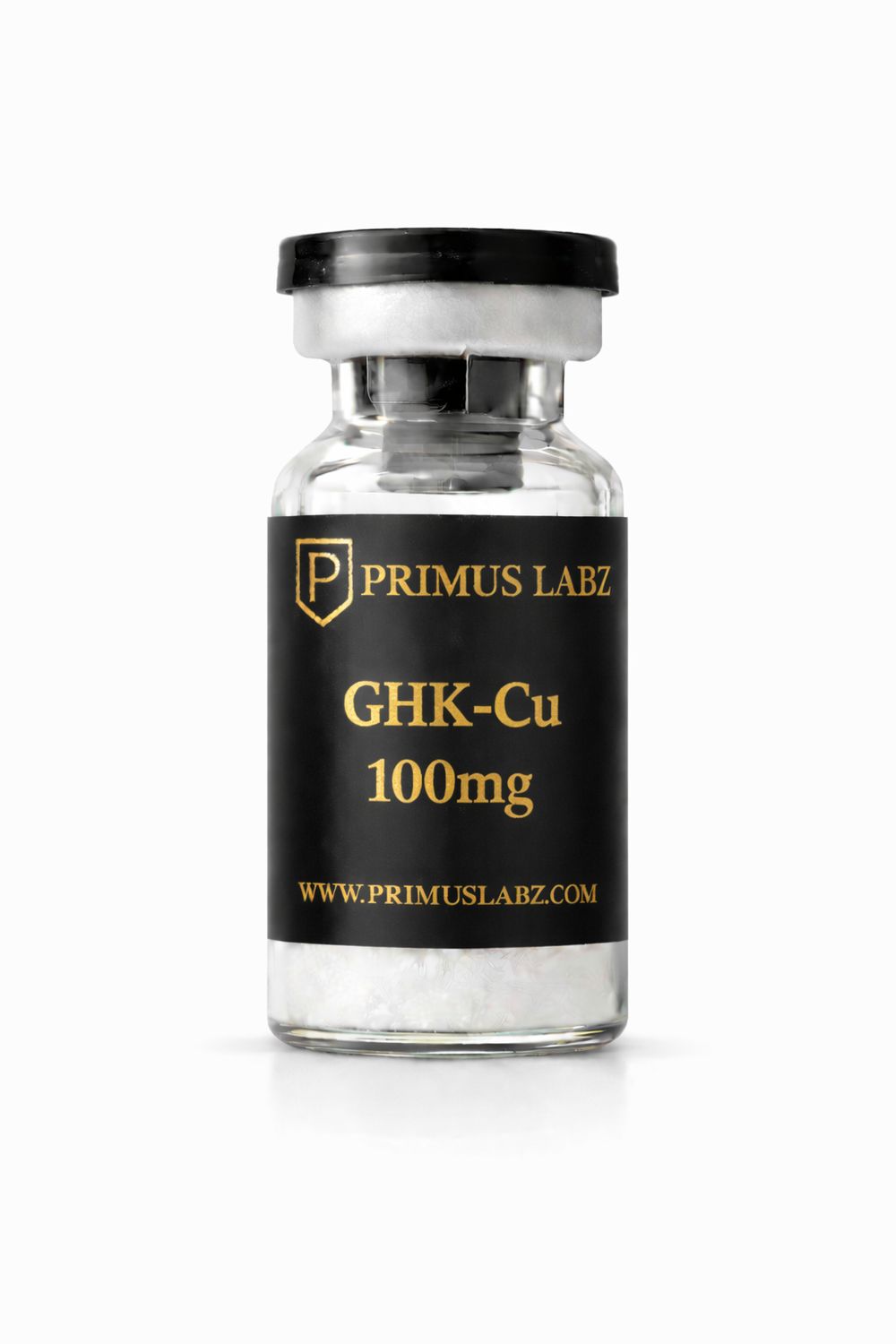
GHK-CU 100mg
$60.00
In stock: 29 available
Product Details
🔬 GHK-Cu — Overview
GHK-Cu (also known as Copper Tripeptide-1 or Cu-GHK) is a naturally occurring copper-bound peptide composed of the tripeptide glycyl-L-histidyl-L-lysine coordinated with a copper(II) ion. It was first isolated from human plasma and is found in tissues, saliva, and urine. In research settings, GHK-Cu is studied for its roles in tissue remodeling, wound healing, collagen and elastin synthesis, antioxidant and anti-inflammatory effects, and regenerative biochemistry.
📌 Brief Functional Description
- Small tripeptide–metal complex that naturally occurs in the body.
- Studied for collagen and extracellular matrix support, wound healing, antioxidant effects, and tissue regeneration pathways in preclinical research.
- Popular in basic research and cosmetic science for skin rejuvenation and dermal biology due to its ability to influence fibroblast activity and structural protein expression.
🧪 Chemical & Structural Information
🔢 CAS Number
- 49557-75-7 — widely referenced CAS for GHK-Cu.
(Some sources also list 89030-95-5 as an alternative CAS depending on salt/form.)
🧬 Amino Acid Sequence
- Gly-His-Lys (glycyl-L-histidyl-L-lysine) coordinated with a Cu²⁺ ion.
In one-letter code: GHK with copper bound.
⚖️ Molecular Formula
- C₁₄H₂₄CuN₆O₄ — elemental formula for the copper-bound complex.
(The free peptide without copper is C₁₄H₂₄N₆O₄.)
⚖️ Molecular Weight
- ≈401.9–404.9 g/mol (Da) — approximate molecular mass of the GHK-Cu complex with copper bound.
For the free peptide (without Cu), the weight is around ~340.4 g/mol.
🧬 Chemical Structure
- GHK-Cu is a copper-chelated tripeptide in which the Cu²⁺ ion coordinates with the peptide’s histidine imidazole nitrogen and backbone nitrogen atoms as well as contributions from neighboring groups, forming a stable peptide–metal complex.
The peptide backbone is:
H-Gly-His-Lys-OH + Cu²⁺ …with copper bound in a chelate configuration.
🧠 Research Context & Mechanism
- GHK-Cu levels in human plasma decline with age, and this decrease correlates with reduced tissue repair and regenerative capacity in older individuals.
- Regenerative functions have been observed in experimental models, including stimulation of collagen, glycosaminoglycan synthesis, and fibroblast activity, as well as anti-inflammatory and antioxidant pathways.
- In dermatological research and cosmetic formulations, GHK-Cu is widely studied for skin health, wound healing, improving elasticity, and cellular matrix support.
⚠️ Safety & Regulatory Notes
- Research Use Only: GHK-Cu is typically supplied for laboratory and investigational research, including in vitro and model organism studies. It is not approved as a therapeutic drug.
- Cosmetic and experimental topical uses often involve formulations designed to stabilize the peptide complex and facilitate delivery to the extracellular matrix.
🧪 Quick Reference
| Property | Detail |
|---|---|
| Name | GHK-Cu (Copper Tripeptide-1) |
| Synonyms | Cu-GHK; Copper peptide; Prezatide copper |
| CAS # | 49557-75-7 (primary form) |
| Sequence | Gly-His-Lys with Cu²⁺ coordination |
| Molecular Formula | C₁₄H₂₄CuN₆O₄ |
| Molecular Weight | ~401.9–404.9 Da |
| Type | Copper chelate of a tripeptide |
| Research Focus | Tissue repair, collagen synthesis, regenerative biochemistry |
Customer reviews
Reviews only from verified customers
No reviews yet. You can buy this product and be the first to leave a review.
GHK-CU 100mg