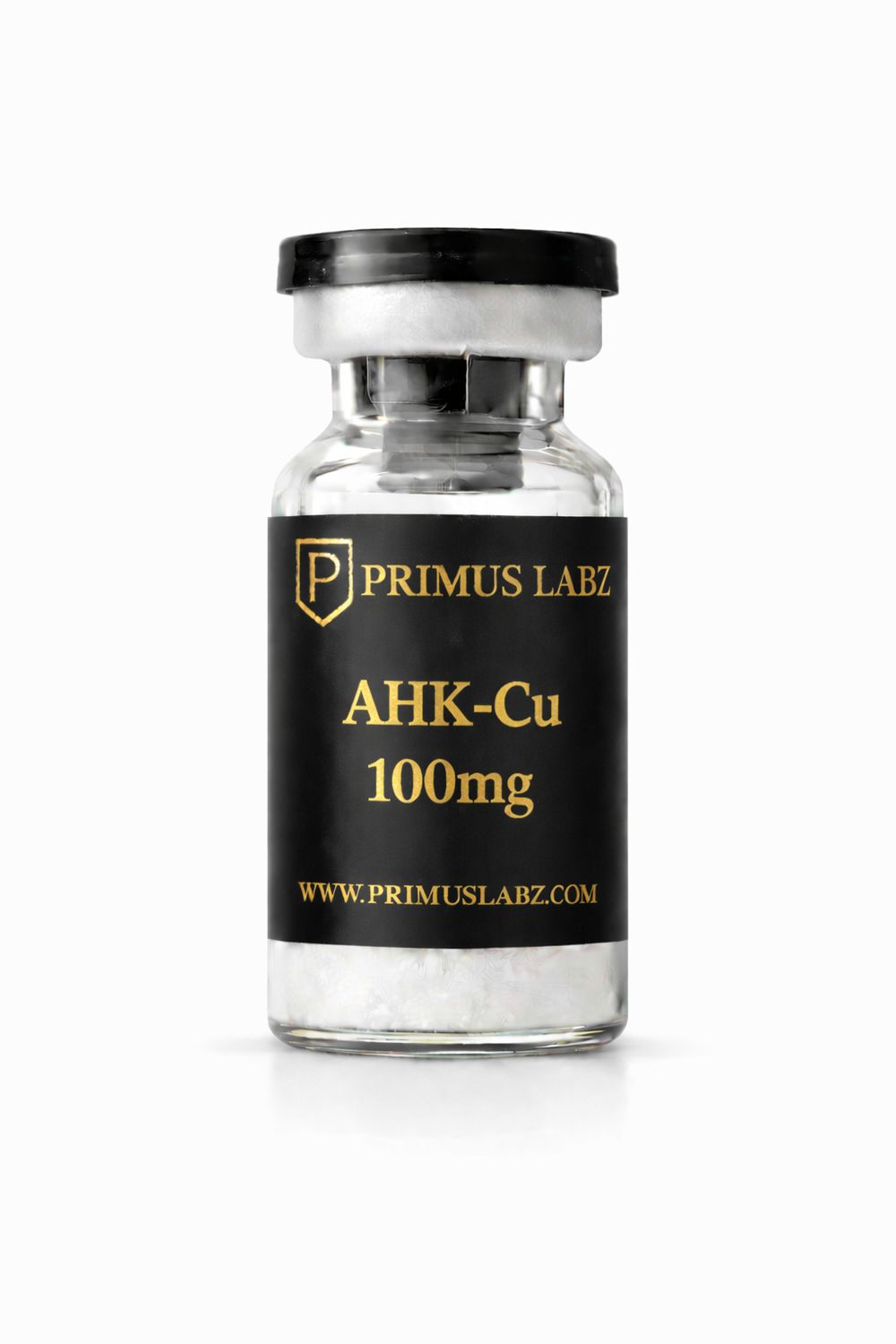
What AHK-Cu Is
AHK-Cu is a copper-complexed tripeptide consisting of three amino acids—alanine (A), histidine (H), and lysine (K)—coordinated to a copper ion (Cu²⁺). It’s a member of the copper peptide family studied in research contexts for extracellular matrix remodeling, fibroblast activation, skin and hair biology, and tissue regeneration pathways. AHK-Cu is often explored in topical formulations and laboratory studies to investigate collagen synthesis, angiogenesis signals (e.g., VEGF), cellular proliferation, and antioxidant responses.
CAS Number
- 767286-83-9 — This CAS is associated with AHK-Cu (often referenced in supplier ingredient listings).
Molecular Formula
- C₁₅H₂₅CuN₆O₄ — This represents the peptide combined with the copper ion (copper(II) complex).
Molecular Weight
- ≈416.9 g/mol — Approximate molecular weight for the AHK-Cu complex, including the coordinated copper.
Structural Overview
- AHK-Cu is not a single organic small molecule in the traditional sense but a metal-peptide complex. The peptide backbone (Ala–His–Lys) binds copper(II) primarily through the histidine side chain, stabilizing the complex and giving it bioactive properties.
Research Context & Mechanism
In research and preclinical studies:
- AHK-Cu may stimulate fibroblast proliferation and extracellular matrix (ECM) remodeling, including collagen and elastin synthesis.
- It’s hypothesized to influence angiogenesis signaling (e.g., VEGF production) and possibly support vascular and follicle biology, which underlies interest in skin and hair science investigations.
- These effects are typically studied in vitro or in tissue models and are still an active area of investigation.
Notes
- AHK-Cu is commonly used in cosmetic research and topical formulations (e.g., hair/scalp treatments, anti-aging serums) but is classified for research use only in many contexts.
- It shares conceptual similarity with other copper peptides like GHK-Cu but differs in its specific peptide sequence (Ala-His-Lys vs. Gly-His-Lys).